Thursday, April 27, 2006

Internaltional - Compost Awareness Week 2006

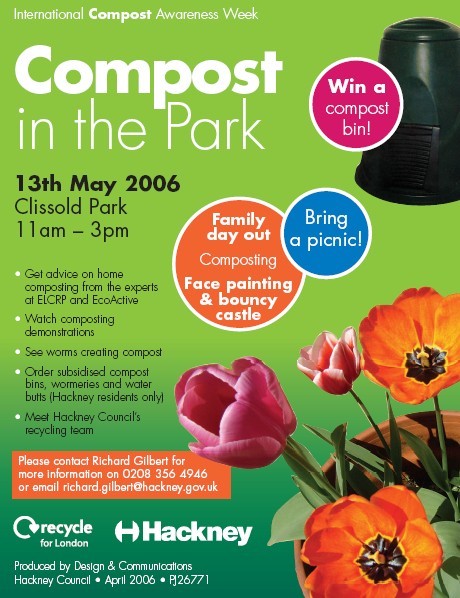
Compost Awareness Week 2006 is an annual showcase for composting in the UK. Organised by the Composting Association, it aims to raise the profile of compost and composting amongst the public and the media. This years the compost week is between the 7th to the 13th of May, 2006.

The initiative came to England from Canada six years ago and is an international education initiative to showcase the production of compost and demonstrate its uses. During the week, all kinds of organisations involved with compost - from manufacturers to local authorities and retailers - are encouraged to get involved and hold events to promote the use and benefits of compost in their local area.

Hackney and many other boroughs in London and UK wide are raising the benefits of composting through various events and workshops. Above an image of the poster which will be around Hackney soon.

This is a graphic extracted from WRAPs compost website (pdf file)


Technorati Tags: waste minimisation

Wednesday, April 19, 2006

Hackney Real Nappy Network

They just released their 1st newsletter. This group of mums are really setting an example in London! Click the image


They got together thanks to the efforts of Nappy Ever After, Hackney Council (Recycling) and above all Hackney mums on 22 June 2005. The same day Hackney launched their £51 subsidy to help cut the cost of purchasing real nappies.

Technorati Tags: waste minimisation

Thursday, April 13, 2006

UK- Real Nappy Week approaching

Why use real nappies?

Around 3% of waste in the UK comes from disposable nappies. This is equivalent to the weight of nearly 70,000 double decker buses each year. Real cotton nappies are easy to use, soft on the skin and don’t contain absorbent gels. Real nappies are cheaper. You could save around £500 per baby if your wash your own nappies. Hackney Council and its neighbouring boroughs (Camden, Islington, Enfield , Waltham Forest , Haringey & Barnet ) offers a £54 subsidy for you to start using real nappies, whether you choose a nappy laundry service or to home launder them. Fully funded by the North London Waste Authority.

Laundry Services operating in North London:
Nappy Ever After
Number One for Nappies

This is the leaflet our team produced for the events in Hackney Real Nappy Week, come along!


Technorati Tags: waste minimisation

Monday, April 03, 2006

USA - San Francisco group resists new purchases

The power of the internet harvest the potential of the Compactors from the group The Compact set up in San Francisco.

The question is What would happen if you gave up shopping for a year? The Guardian reports that a group in San Francisco, calling themselves the Compactors, have agreed not to buy anything new (apart from items related to food, health and work) for the whole of 2006. It's not even as easy as it sounds.

What about underwear? (All other clothing must be bought second-hand, but underwear has been exempted.) Is the carbon footprint of a bought can of beans greater or smaller than making them yourself at home?

The Yahoo group set up by the Compactors has become an interesting documentation of the questions that beset many consumers, but it also offers helpful suggestions (and has a links page that illustrates just how hard many people are thinking about these things - for example, every month San Francisco holds the Really Really Free market where everything is swapped). There are ways of crocheting bath rugs out of plastic bags, recipes for making paper, eulogies about growing your own food and spats about whether religion plays a part in this mindset. This is very similar to the Give or Take events taking place around Europe and in London, Hackney.

The Compact has several aims (more or less prioritized below):

We are a group of individuals committed to a 12-month flight from the consumer grid (calendar year 2006).

To go beyond recycling in trying to counteract the negative global environmental and socioeconomic impacts of disposable consumer culture and to support local businesses, farms, etc. -- a step that, we hope, inherits the revolutionary impulse of the Mayflower Compact.
To reduce clutter and waste in our homes (as in trash Compact-er).
To simplify our lives (as in Calm-pact)

Their blog, click here
Their Yahoo Group, click here


Technorati Tags:

Monday, March 27, 2006

UK - paint scheme diverts 151,000 litres from landfill

Research published by environmental consultancy SWAP shows that the paint reuse scheme Community RePaint increased the amount of paint it diverted from landfill by 15 per cent last year. Between August 2004 and July 2005, 151,500 litres of paint were redistributed by the network's 62 schemes, an increase of 19,000 litres on the previous year.
The paint was donated by members of the public at household waste recycling centres, DIY retailers and to the schemes directly. It has been used in a variety of innovative ways from decorating a lighthouse in Cardiff to painting murals. The Community RePaint network also provides additional social benefits through the creation of employment and volunteering opportunities, supporting 72 part time and full time jobs and 138 voluntary positions.

From: Resource Recovery Forum

Technorati Tags: waste minimisation

Monday, March 20, 2006

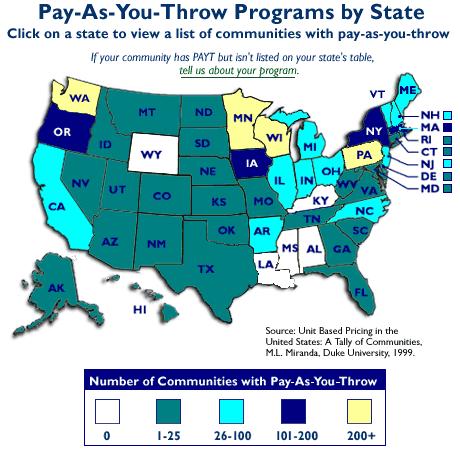
USA - Pay-As-You-Throw Programs (PAYT)

Traditionally, municipal solid waste collection and disposal services have been financed through property taxes or by fixed annual fees charged to households. At the same time, households are charged according to their rate of use for other utilities such as water and sewer service or electricity. As a result, residents often mistakenly perceive that solid waste services are free because of the separation between cost of services and how they pay for them. Citizens have little direct financial incentive to reduce the amount of waste they produce. Also, because each household is generally charged the same amount, small generators subsidize garbage services for those who throw away more.

Many local governments are adopting Pay-As-You-Throw (PAYT) programs for both curbside and drop-off collection systems. With PAYT, also known as “variable rate financing” or “unit pricing,” customers are charged by weight, by volume, or by a combination of the two per unit of garbage disposed. Market-based approaches such as these are proving to be important tools for dealing with environmental issues. With only a dozen PAYT programs in the late 1980s, the United States now has more than 4,000 communities with such programs.1 PAYT programs have been mandated in both Minnesota and Wisconsin. More than 30 North Carolina communities are using or are part of larger (county-run) PAYT programs.

Benefits of PAYT: These programs offer a myriad of benefits for local governments. Furthermore, PAYT programs can be structured to maximize particular benefits. Some benefits of PAYT are:

• Economic Incentives to Reduce – PAYT creates a direct link between waste disposal and cost resulting in a true economic incentive to reduce the amount of waste generated and recycle as much as possible.

• Reduced Solid Waste Tonnage – In most communities, the realization of costs associated with waste management results in a decreased tonnage of waste to be disposed. This decrease is attributable to both source reduction and increased recycling. A reduction in the tonnage of waste disposed generally results in savings from reduced tipping fees.

• Increased Recycling – The easiest way system users can save money is through increasing recycling. Increases will vary in size based on public education programs and the level of services available. Communities that receive revenues from recycling will see an increase in recycling revenues, however, these revenue increases may be quickly off-set by increased recycling hauling costs.

To read more go to this pdf link

EPA's website is very comprehensive, read the FAQ page to learn more. It's worth reading this website to case studies. This map was extracted from this website


Technorati Tags: waste minimisation

Japan - Bring your own cup

Japan - Trade Ministry tests "bring your own cup" vending machines

The Japanese Ministry of Economy, Trade and Industry has installed a vending machine that allows consumers to use their own cups when they purchase drinks in the elevator lobby of the ministry building. Japan for Sustainability reports that the aim is to conduct research on consumer behaviour and convenience. This experiment, the first of its kind undertaken by a government or other public office, started on November 1, 2005.

There are about 160,000 paper cup vending machines in Japan, and it is estimated that about 2 billion paper cups are consumed every year. Should "Bring Your Own Cup" vending machines come into common use, consumption of paper cups is expected to decrease by 20 to 50% .The ministry pins high hopes on the spread of BYO cup vending machines as an effective way to reduce consumption of containers and packaging.


From: RRF news

Technorati Tags: waste minimisation

Monday, February 27, 2006

Waste of packaging finalist from Treehugger

Here a Treehugger article from their blog

"For those of us who still think a good peanut butter and jelly sandwhich is manna from the heavens, Kathleen Robinson's entry into the contest is especially heartbreaking - individually wrapped peanut butter slices. Obviously, individually wrapping each "slice" of peanut butter creates quite a bit more packaging than a simple jar would. However, Kathleen thinks she may have an even better idea, "It seems to me the inventor of this "unsticky" peanut butter could have simply sold his peanut butter in blocks, like cheese, that could be sliced with a cheese cutter (creating even less waste than a regular peanut butter jar?). Consumers could maybe even use a cheese grater on a block of peanut butter, creating shredded peanut butter, which I imagine would be good for cookies, or icecream." We're still not sold on "unsticky" peanut butter, however Kathleen's block o' peanut butter looks much better than a pile of plastic any day. Check out the picture after the jump..."

The different comments from Gizmondo and Treehugger blogs are obviuos, the Gizmondo ones are more happy to find out where they are sold, caring zero to nothing about the whole idea of the packaging waste headache(not all though!) and Treehuggers are criticizing more the packaging problem in our shops and bins.

Technorati tags:

Wednesday, February 22, 2006

Zero Waste - Introduction

Zero Waste is a movement to emulate natural cyclical processes where no waste exists. It will require to re-design our resource-use system. Every stage of any resource-use process must be so designed as to ensure that nothing is generated as an output, deliberately or otherwise, that does not become a useful input into another process. Any output that is destined for land, sea or air should not be a threat to planetary, animal or plant health. It seeks replace waste management with resource management.

While this is a laudible aspiration it is difficult to see how the transition from our current consumerist society could be managed as many items have been designed for a limited lifespan and will require disposal. However, this initiative provides a solution to pollution and depleting natural resources.

The movement gained publicity and reached a peak in 1998-2002, and since then has been moving from "theory into action" by focusing on how a "Zero Waste Community" is structured and behaves. The website of the Zero Waste International Alliance has a listing of communities across the globe that have created public policy to promote Zero Waste practices. See also the Eco-Cycle website for examples of how this large nonprofit is leading Boulder County, Colorado on a Zero Waste path and watch a 6-minute video about the Zero Waste big picture. Finally, there is a USA Zero Waste organization named the GrassRoots Recycling Network that puts on workshops and conferences about Zero Waste activities.

Extracted from Wikipedia

Tehcnorati Tags:

Wednesday, February 15, 2006

England - Government consults on waste strategy

England - Government consults on waste strategy

New targets to recycle up to half of all household waste is just one of a number of proposals in a major consultation on the Government's strategy for waste in England.

Launching the consultation, Minister for Local Environment Quality, Ben Bradshaw said "We've made some really positive progress since 2000: recycling and composting of household waste has doubled, nearly 50 per cent of packaging waste is being recycled and less waste is being sent to landfill. We need to put more effort into producing less waste in the first place, before considering how to make more use of the waste which is left by reusing, recycling, composting or using it as a fuel".

In a YouGov survey for Defra, only 3% of people always think about how they are going to get rid of the everyday items they buy when they no longer need or want it, half of people admitted that it never crosses their minds. Indeed, many people thought they were paying more for waste collection, treatment and disposal than they actually were. Most people (38%) think that it currently costs local authorities £10 per week to collect and deal with their household waste, in fact it is on average just £2 per household.

Among the measures being proposed are:

*Greater focus on producing less waste in the first place by:
• developing a greater emphasis on eco-design
• increased engagement with businesses and householders on waste prevention
• more agreements with businesses to take greater responsibility for their products at the end of their life

*New recycling and composting targets for household waste are proposed:
• 40% in 2010
• 45% by 2015
• 50% by 2020

Recovering more resources from businesses waste with new targets for a reduction in the proportion of commercial and industrial waste landfilled, more help for small businesses and a more joined up approach in managing waste from different sources facilitated by local authorities and regional bodies.

Making proper use of new investment to recover energy from waste as an alternative to landfill, but not at the expense of practical waste prevention and recycling by seeing a more modest growth than original estimates. It is proposed to set a target for 67% recovery of waste by 2015 by recycling, composting, energy from waste (incineration, pyrolysis and gasification) and digestion with at least 45% composting and recycling.

The consultation paper Review of England's Waste Strategy A Consultation Document February 2006 (0.8MB) is available from Defra's website

On leave

I will be on leave until monday the 20th. Thanks

Thursday, February 09, 2006

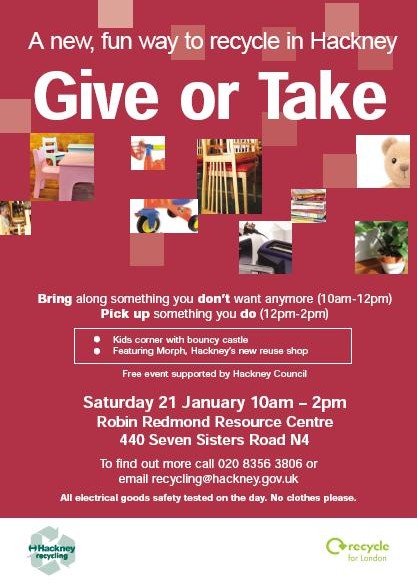
Give or Take - Hackney

...leaflet to promote the event...

The Give or Take that I organized for the 21 January in Woodberry Down area, Hackney, London was another success. We had plenty of stuff! From bric-a-brac to large furniture, including 15 chairs, that were all taken! Hackney residents are happy to have these kind of events happening in the borough. 1 tonne of goods were reused and hardly any was disposed.

I read this article "Give and take": People flock to Freecycle.org to find new homes for unwanted goods in the NCTimes, from North San Diego and Southwest Riverside County News, USA. It says "an exploding online community of creative recyclers: The Freecycle Network, where thousands of San Diegans are coming together to give and take free stuff. " There is also a UK version as well as other many other countries.

These are some of the goods that came and left on that day:

A very old radio, no FM, but still nice looking vintage

Some of the furniture that was given but also, lets remember "Taken"!

There were also plenty of soft toys and games for kids to take home, which is great for those parents that cant afford it

Stickers are put on top of large furniture/goods so is known that it has been taken

...also books are a major given goods in the day, some very old, others only days new. Some of them are given to charity if they are not taken

Tehcnorati Tags:

Tuesday, February 07, 2006

Scotland waste is growing at an alarming rate !

The Scottish Executive Environment Group Preventing Household Waste in Scotland A Consultation Paper

The amount of household waste produced in Scotland is growing at an alarming rate and if changes aren't made it may double within 20 years. The average Scottish consumer wastes £1597 per year on goods and services that they don't use, £438 of this is uneaten food.

In a bid to stem this disturbing growth in waste, the Scottish Executive and the Scottish Environment Protection Agency (SEPA) have published a consultation paper detailing actions which could be taken by everyone. Questions are being asked of designers, retailers, consumers and local authorities and include;

• What more can be done to promote ecodesign in Scotland, and what can be done to lengthen the lifespan of products?
• What further action could be taken to minimise packaging waste and would deposit-refund schemes be the answer?
• What information on products should be used to help people choose low waste alternatives?
• Should we look further at charging households for the amount of waste they produce?
• What could be done to reduce the amount of junk mail we all receive, and the numbers of plastic bags that we consume?

What is waste prevention?

There are a number of definitions of waste prevention. The consultation document takes it to mean:
Strict avoidance - the complete prevention of waste generation by, for example, reducing unnecessary consumption
Reduction - reducing waste by designing and consuming products which generate less waste
Product re-use - re-using a product in its original form, for its original purpose or for an alternative use
Qualitative waste prevention - reducing the hazardousness of waste.

What policy tools are available to tackle waste prevention?

There are a range of policy instruments to tackle waste prevention, including:

Economic instruments. e.g. taxes. Fiscal measures are a reserved matter for HM
Treasury, although local taxation is a devolved matter.
Incentives e.g. deposit-refund schemes.
Legislation e.g. producer responsibility legislation, bans on certain hazardous
materials and on certain materials going to landfill, direct and variable charging for
the collection of household waste.
Education and awareness raising, to change values/attitudes and then behaviour, e.g.
‘resource efficient shopping’, home composting, real nappies.
Voluntary agreements and partnerships such as supply chain and community
partnerships, e.g. on product design and packaging, take back/reuse, and direct
marketing.

“Local authorities are well placed to take a lead on waste prevention and are key in engaging local communities to take part in waste prevention activities.” Women’s Environmental Network.

Page 25 discusses Local Authorities role on waste prevention measures

You can download this file (pdf) in here

Friday, February 03, 2006

Europe - top priority to waste prevention

The EU waste strategy gives top priority to waste prevention, followed by treatment measures such as recycling, re-use, incineration (with energy recovery), and as a last resort, landfilling. Precluding the increasing quantities of municipal waste from landfilling is forecasted to lead to an increase in the volume of incinerated waste across the EU and expand the related recycling market.

So lets remember whats coming, or what needs to be done to improve the current situation within prevention/minimisation schemes.

Wednesday, February 01, 2006

Australia report shows 27.7% reduction in plastic bag use likely in 2005

Good news from Australia!

Consultants Nolan-ITU have published an update report providing estimates on the use of single-use lightweight plastic carry bags in the period January to June 2005, and compares these figures against the December 2002 baseline.

The report draws the following conclusions:

There is clear evidence from bag import data and Australian bag manufacturers that there has been a reduction in bag usage in Australia between 2002 and 2004, which has continued into 2005.

It is estimated the reduction in lightweight HDPE bags from 2002 to the end of 2005 will be 27.7% or 1.65 billion bags per year.


The reduction in the supermarket sector is estimated to be higher than other retail sectors reflecting a higher level of activity by companies and community organisations in these stores. It is estimated that the 2002-2005 reduction in the supermarket sector is 33% or higher if adjusted for store growth.

The reduction in LDPE shopping bags has been more significant in 2005, with imports dropping an estimated 68.5% from 2002 imports. Industry observations are that the reductions in bag use over the past two years are the result of increased consumer awareness, better staff training and the more widespread availability and use of heavier duty reusable carry bags.

In 2003, the Environment Protection and Heritage Council (EPHC) challenged Australian retailers to establish a National Code of Practice for the Management of Plastic Bags which included a range of targets relating to the reduction and recycling of retail carry bags. These targets included a 25% reduction in the number of HDPE bags issued by end of 2004 against the base of December 2002 and a 50% reduction by the end of 2005.

In response to this challenge, the Australian Retailers' Association (ARA) developed a Code of Practice for the Management of Plastic Bags. This included a commitment to the EPHC targets. The ARA Code focuses on HDPE carry bags. (It was estimated in 2002 that HDPE bags account for over 85% of total carry bags by number.) The ARA submitted a report to the EPHC on the progress of activity (including progress against the target of 25% bag reduction by the end of 2004).

A further report in early 2005 reported progress to end of 2004. The ARA has submitted a further report to the EPHC on the progress of activity in September 2005. In August 2005 the Department of Environment and Heritage (DEH) engaged Nolan-ITU to undertake a study to report on bag usage over the period January to June 2005. The aim of the study is to identify the level of bag use across all retail sectors and to compare this to data presented in December 2002.

The methodology utilised in the study is therefore focussed primarily on data obtained at a bag manufacturers' and import level. Where possible, supporting data has also been obtained from retailers across many retail sectors.

Copies of the interim report Plastic Retail Carry Bag Use 2002 - 2005 Consumption (0.2 MB)
Download the pdf from the DEH's website

Info provided by RRF email subscription

Thursday, January 19, 2006

Canada - Quebec's Bill 390 to ban plastic bags "a step backward for the environment"


The bag debate is an open one, here we can find an anti-biodegradable bag views:

Quebec. A private member's bill introduced in the Quebec National Assembly is an intervention in search of a 'problem'. Bill 390 would prohibit plastic shopping bags that are non-biodegradable. What is the rationale? Is it a concern over litter? The amount of residential waste going to landfill?

Here are the facts:

Independent audit studies have shown that plastic shopping bags account for less than half of one per cent of litter - Plastic shopping bags account for less than 1% of residential solid waste in landfill sites

More than half of all plastic shopping bags are re-used

The domestic plastics industry was the first in the world to work with government to implement curbside collection programs for plastic shopping bags, and Quebec has been a major supporter of these recycling programs. More importantly, Bill 390 likely would have negative consequences for the environment. If only biodegradable plastic shopping bags are permitted, those bags that do go to landfill will decompose - releasing leachates into the groundwater and methane gas into the atmosphere. That's why countries around the world are moving to reduce biodegradable materials in landfill. For example, the European Union has set out statutory diversion targets to reduce the amount of biodegradables in landfill by 65% over the next 15 years. Bill 390 flies in the face of modern landfill management practices, and would move Quebec backward - not forward - in protecting the environment. This bill could also create other problems. Some municipalities in the province have already publicly expressed their concerns about the potential negative impact of biodegradable plastic shopping bags on their recycling programs - for example, contaminating the recycling stream, causing sorting problems, and increasing costs.

Plastic bag manufacturers take seriously their commitment to product stewardship. The industry works with retailers to promote the proper packing and use of bags. It works with municipalities to expand curbside recycling. It helps to develop viable markets for recycled plastic bags. It provides consumer information about re-use and recycling."Our goal is to keep as many plastic shopping bags as possible out of landfill," said Denis Cloutier, Chair of the Canadian Plastics Industry Association (CPIA). "But for those bags that do go to landfill, biodegradability is not the answer. Bill 390 would do more harm than good. It would hamper efforts to reduce greenhouse gas emissions and meet our Kyoto commitments. It could disrupt existing recycling efforts.""The bill shows a lack of understanding of the facts," Cloutier added. "For all of these reasons, we expect it will be defeated."The Canadian Plastics Industry Association represents the broad plastics sector, including resin suppliers, mold and machinery equipment manufacturers, processors, reprocessors, brokers and recyclers.

In Canada, plastic bag manufacturers employ more than 3,000 people.

Well, my opinion, plastic bags wont desintegrate easily, but when do they after many years or even centuries, it will decompose into harmful chemicals, which end up in the water streams. How many people does the biodegrabable bag manufactures employ? and the recycling sector?

We need more credit, less rubbish.
Monday, January 16, 2006

South Korea - rubbish bag prices to rise 40%

The government of South Korea has decided to raise the prices of plastic garbage bags by some 40% over the next three years to encourage businesses and households to generate less waste.The Korea Times reports that the Ministry of Environment said on that the price of a 20-litre plastic garbage bag for household use would increase to an average of 540 won (55 cents) by 2008 from the current 384 won. Korean households and businesses are required to purchase and use specific garbage bags issued by their respective municipal governments when disposing waste. They also need to separate recyclable items from conventional waste that are put into the garbage bags and buried in landfills.

Local governments set their own prices for garbage bags whose colors and designs are different from one municipality to another. The bags issued by a certain municipal government cannot be used in other cities and provinces. Meanwhile, the ministry said South Korea has saved a total of 7.7 trillion won on waste disposal costs over the past decade when the government introduced the current volume-rate garbage disposal system. The country has also earned 311 billion won from recycling various items over the same period, according to the ministry. It said Korea's daily per-capita waste generation decreased 23 percent to 1.03 kilograms in 2004 from 1.33 kilograms in 1994, while the amount of recycling rose 175 percent.The per-capita figure is less than the average of Organization for Economic Cooperation and Development (OECD) member nations as citizens in 30 countries generated a daily average of 1.56 kilograms of waste per person. The ministry says the majority of Koreans are satisfied with the effectiveness of the volume-rate garbage disposal system in reducing the amount of waste. In a survey of 700 respondents nationwide, about 85 percent gave positive responses on the system, while 10 percent disapproved of it.The ministry says a substantial number of households, particularly in rural areas, still illegally incinerate and dump garbage to avoid paying for the garbage bags. It plans to improve the current reward system for those who report illegal activities regarding waste disposal, and encourage municipal governments to computerize garbage collection and disposal procedures.

From ResourceNotWaste

Thursday, January 12, 2006

Waste Implementation Programme: Waste Minimisation

The U.K. Government set out its vision for sustainable waste management in Waste Strategy 2000, the national waste strategy. They are also committed to reducing the amount of biodegradable municipal waste landfilled, in accordance with European Directives.

The Waste Implementation Programme responds to measures recommended by the Strategy Unit report "Waste Not, Want Not" on local authority support; R&D; and waste minimisation, awareness and kerbside collection.

The Waste Minimisation programme began in 2003 and will work to stem the growth of household waste, as a vital part of the package of measures needed to enable the UK to meet the requirements of the Landfill Directive and move towards sustainable waste management

Their objective aims to support the UK’s objectives by achieving household waste reduction equivalent to deflecting the annual rate of waste increase from 3% to 2% by fiscal end 2006

A major retailers initiative, seeking to work with the top five supermarket chains - both challenging them and supporting them to play their part in the key objective set for reduction of growth of household waste. These are the three key programmes:

Very interesting document!

International waste minimisation initiatives - Defra commissioned Enviros Consulting to look at the waste minimisation initiatives in other countries. Enviros published its report International waste prevention and reduction practice in October 2004. Please note that although this report was produced for Defra, it is only for information and does not reflect Government policy. N.B. The copyright in this report belongs to Enviros Consulting Ltd.

International waste prevention and reduction practice: final report (358 KB)

Wednesday, January 11, 2006

Mr Paper - Reuse scrap paper in the office

I started a Mr Paper scheme within the office. Reuse scrap paper and print less.

Follow these points:

*First of all make sure what you printing is really necessary, don’t just print to make yourself feel better, remember this is a resource that comes from trees, in our case recycled paper.
*If you DO print, check out some simple printing steps:

o Double sided: Print double sided if you have got a large document. (Ask me if you don’t know how to)
o For small number of pages

* Reduce the font
* Delete spaces so that there isn’t a single sentence on just one page
* “2 sheets per paper”: Go to “Print” check the Zoom section, click sheets per paper and choose “2 sheets per paper”
* Keep sheets with a blank side and put it in the Scrap Paper tray next to the printer
* The printer should have scrap paper as default. If you need to print in plain paper, load it yourself, remember to take any left plain paper out of the tray when you finish.

It is vital staff know about it, so if they dont know go one by one and show them what you mean by the above instructions

Results

Mr Paper was first launched in April 2005. It took several weeks for the office to get used to the scheme. Once everyone was aware the team has saved an estimated minimum of 1 ream of 500 sheets a month = 4,500 sheets in 9 months, therefore saving around £115.

April-Nov’05

Plain Paper: 25 reams (13,000 sheets)
Scrap paper: 9 ream* (4,500 sh.)
Money Saved: ~£115
Money Spent: ~£315
Total paper used: 34 reams (17,500 sh)
Total money saved: 35%

Notes:
*Minimum one ream a month
Our paper is sometimes used for the photocopier as well

Summary

* Scrap paper amounts to a quarter of current printing/copying practices. Mr paper believes scrap paper amounts to at least half of our current printing within the recycling team. Most of the plain paper goes to the copy machine used by others in the same floor
* We have saved £115 in 9 months
* The green champion rescues scrap paper from the internal recycling bins when emptying them for the weekly collection. Needs more scrap paper to come from the officers
* Envirowise stated that the average office worker consumes 3 reams (1,500 sheets) a month. We use around 4 reams per month between 6 staff
* Fax machine: This can not be loaded with scrap paper as for unknown reasons it keeps jamming. Unwanted fax prints are still deposited in the scrap tray. Try anyway first

Friday, January 06, 2006

Welcome to 2006 - Less Rubbish as a new resolution

Hi to all,

What will this year bring in terms of new schemes, ideas, events or actual policies taking place?

Let's see!